
Compound Assessment carries out a holistic review of absorption, distribution, and elimination to inform you prior to modeling your compound in GastroPlus®. Within a Compound Assessment, primarily when you have entered measured properties for your compound, you can include a comparison of properties with those predicted from a chemical structure.
To run a Compound Assessment, a Compound (preferably with available measured data entered), a Physiology with a PK model, and a Dosing Schedule are required.
In this tutorial, we will cover:
Compound Assessment for a compartmental PK model
-
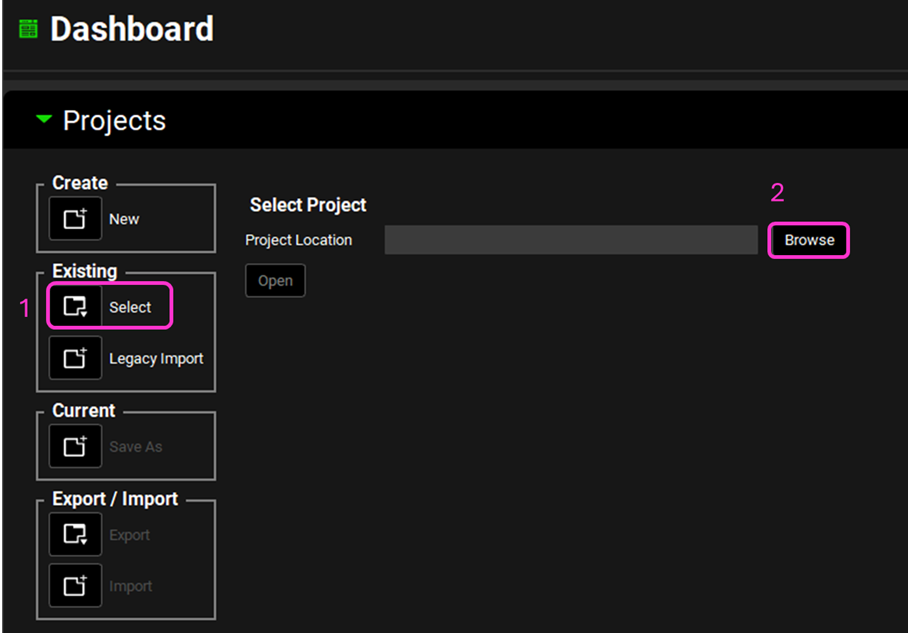
Open GPX™ and, in the Dashboard view, click on the icon next to Select to open an Existing project.
-
Click on Browse and navigate to the C:\Users\<user>\AppData\Local\Simulations Plus, Inc\GastroPlus\10.2\Tutorials\Compound Assessment and select the project “Compound Assessment” by clicking on it and clicking Open.
-
Navigate through the views to familiarize yourself with the assets contained in this project.
-
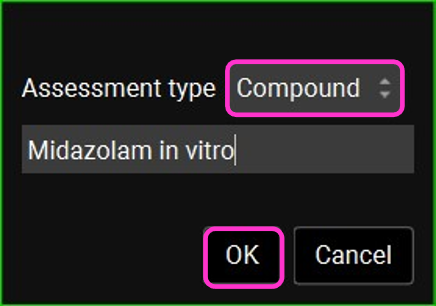
Click on the AssessmentsPlus™ view in the navigation pane and then click on Add. Leave the Assessment type as Compound, enter the name “Midazolam in vitro”, and click on OK or press Enter.
-
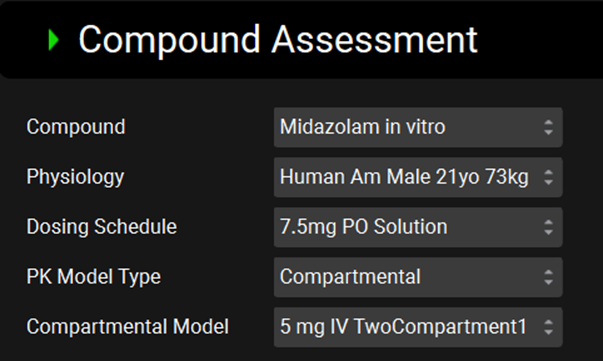
Ensure that the selections for Compound, Physiology, Dosing Schedule, PK Model Type, and Compartmental Model are as below.
-
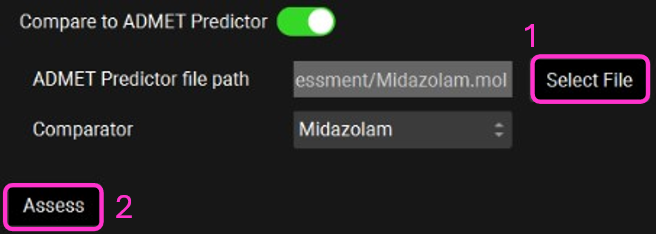
Toggle on Compare to ADMET Predictor, click on Select File, select the Midazolam.mol file, click on Open, and then click on Assess.
-
Review the advice to identify characteristics such as the BCS Class, lipophilicity, pKa values, extent of distribution, and clearance classification.





-
Compare measured properties with predictions.






-
Identify any key points for consideration when modeling your compound.


Compound Assessment for a PBPK model
-
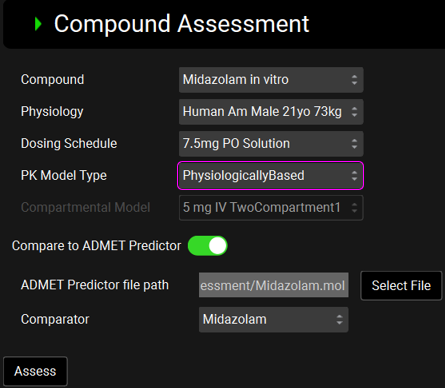
Continue with the project from the Compound Assessment for a compartmental PK model, or follow steps 1 to 6 from above. In both cases, set the PK Model Type to PhysiologicallyBased before clicking on Assess.
-
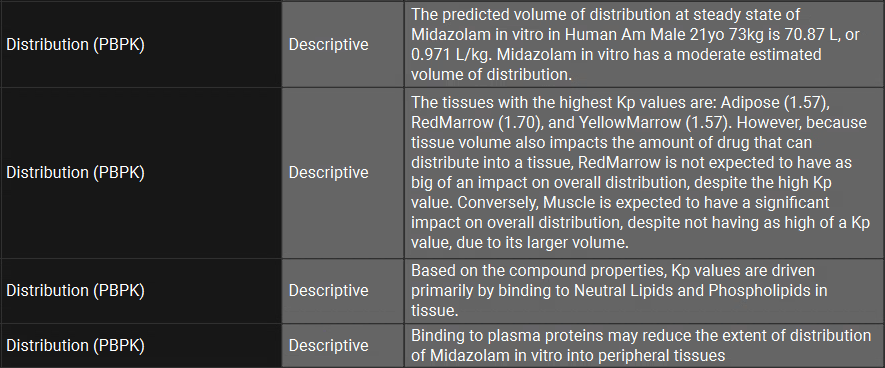
Review the advice to identify characteristics such as the BCS Class, lipophilicity, pKa values, nature and extent of distribution, and clearance classification.




-
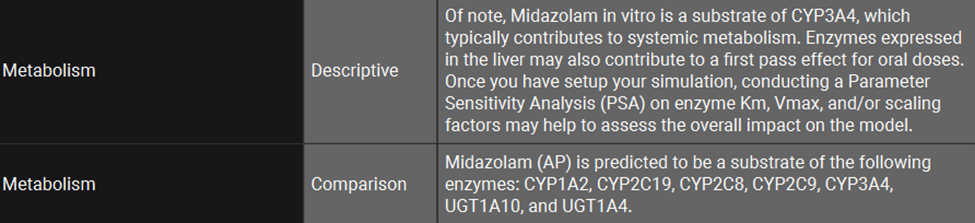
Compare measured properties with predictions.




-
Identify any key points for consideration when modeling your compound.

